Brand As A Living System: When Psychology Meets SEO

A conversation between Jeremy Rivera, host of the Unscripted SEO Podcast, and Charlie Birch, Founder & Creative Director of Humaniz Collective.
Introduction To Charlie Birch: A Background Built for Brand Crisis
Jeremy Rivera: Hello, I'm Jeremy Rivera, your Unscripted Podcast host. I'm here with Charlie Birch, who's going to introduce her company — and as she does, I want her to focus on her experience in life that makes her a trusted expert in her niche.
Charlie Birch: Hi everyone. Jeremy, thank you for having me on the show — I'm super excited to be here.
I am the Founder and Creative Director of Humaniz Collective. And my life — and how it makes me uniquely qualified — actually comes from a place most people don't expect: not marketing, not design. My background is in performance and psychology.
When I was going to be a psychologist, I worked in a psychiatric day school in crisis intervention. So I'm really interested in what goes wrong with brand, what the human impact is, and how we can prevent those crises from taking down the ship. I've had real-life experience with real big crises.
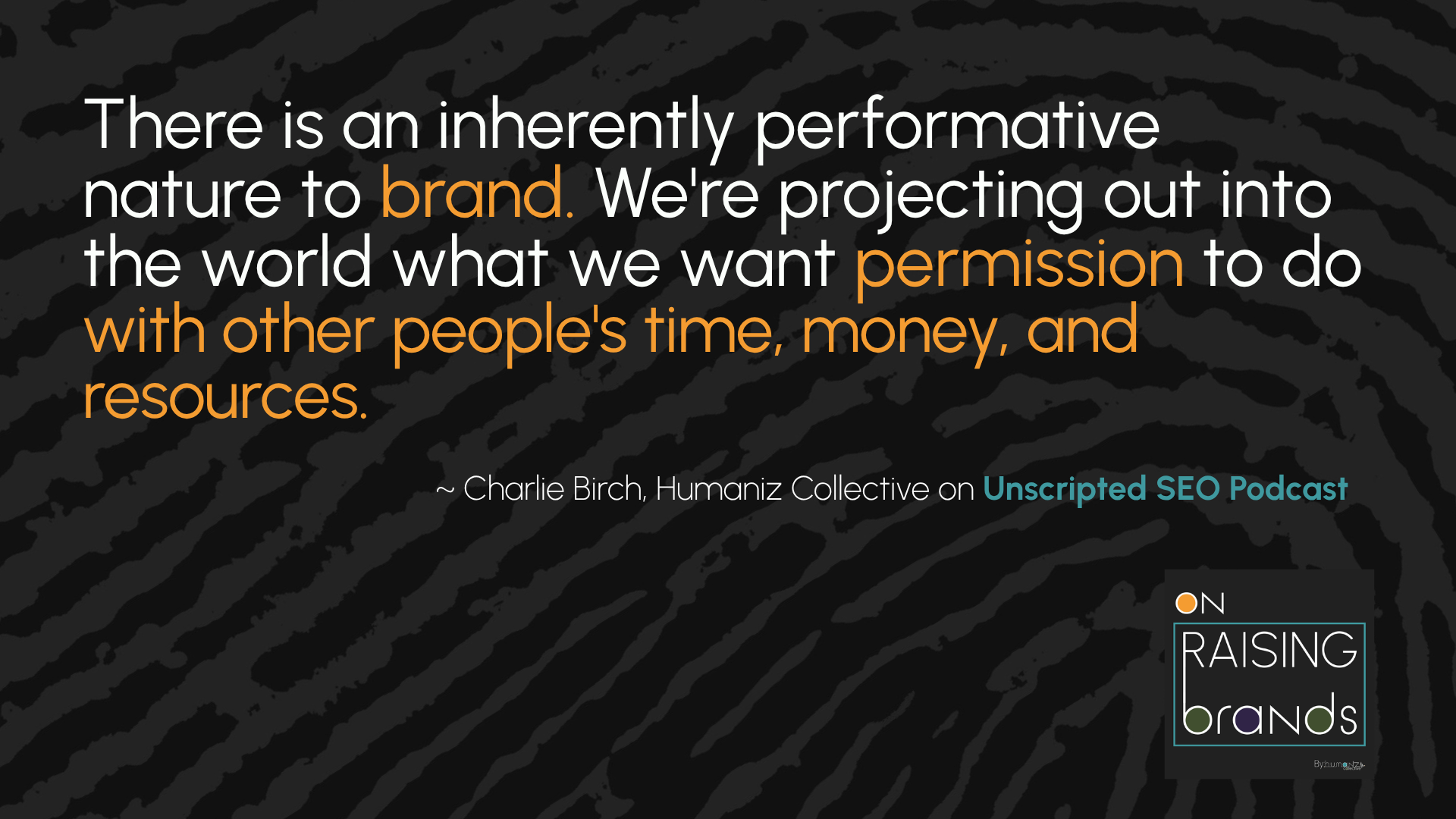
My background is also in performance. Brand is inherently performative. We're projecting out into the world what we want permission to do — with other people's time, money, resources. There's an inherent part of it that requires you to captivate an audience, maintain attention, resonate with them, pull their heartstrings — and to do that without spiraling into a crisis.
2025 has been a really interesting year of reflecting on the full circle of my life trajectory. I've always felt I had transferable skills from my previous chapters — first website design, then brand strategy. But now, doing deep identity development work with our clients and transferring that identity to their organizations, people can actually see what I'm talking about instead of just taking my word for it.
Jeremy Rivera: I would say crisis management is definitely a great additional life skill to handle what's been happening in SEO.
💬 Best Quotes from This Section
"Brand is something I'm really passionate about. My background in crisis intervention actually puts me in a really interesting position to do that work — I'm interested in what goes wrong with brand and what the human impact is."
"There is an inherently performative nature to brand. We're projecting out into the world what we want permission to do with other people's time, money, and resources."
"I really feel, for the first time, when I tell people I have transferable skills, people can see what I'm talking about and they're not just taking my word for it."
Brand, SEO, and the Information Ecosystem
Jeremy Rivera: I want to dig into brand and how you understand it through the lens of Google's hard realities — reflected in the algorithm choices, reflected in what information gets processed and then extrapolated into results.
There are two sides: brand in terms of how you choose to front as a company — and then the stack of marketing resources you create that are supposed to align with that. As my friend Chris Tweeten at Spacebar Collective said: "Publishing more won't fix a weak SEO game. It's about leverage — it's not a volume game." Positioning and personal brand identity matter just as much as the content you produce.
Charlie Birch: I've been witness to — and participant in — many power struggles between brand-oriented copywriters and SEO-oriented copywriters, brand-oriented website designers and SEO-oriented website designers. The pendulum swings.
I recently worked with a longstanding client — a psychotherapy practice. She had a five-page, low-friction website, where all roads led to booking an intake. Then she hired a marketing agency focused on keyword volume and page density. All these new pages, all this new content.
If the assumption is that Jane Doe is going to find the website through one of those pages and then convert — then the design and brand coming through on that page is just as important as the page's ability to rank. I don't see any point in which that will ever be untrue.
The biggest crisis I see is the inability for experts in all those lanes to marry their strategies. Yes, you have a strategy that works for your clients in the narrow lane you're measuring. But what about the periphery?
As AI enters this conversation — remember that when it was simpler tech running SEO, technical, left-brain experiments like keyword density worked until they didn't. They worked until the systems caught up, and then everything reverted back to human-friendliness. Can we shorten the arc of that eventuality and just put humans first?
Jeremy Rivera: I was talking to Matt Brooks about the concept of brand. Joining a big brand like Raven Tools was like jumping on the back of an elephant with all its inertia — five other people all wanting the elephant to go somewhere different. If you're all bopping it from different sides, it just keeps going where it was already heading.
That's why collaborative decisions are key in a fully developed SEO campaign. The days of cracking open your Ahrefs, your Semrush, making decisions in the dark — disconnected from sales, email, the CEO's vision, the product manager's upcoming launch — that doesn't work anymore. Any search volume number should be seen as just a starting point.
The organic space is getting sandwiched — paid ads, number-one organic, AI overview, and then three blue links where there used to be ten. The pool is shrinking. You can't rely solely on keyword volume optimization. You have to think about long-term audience acquisition and how you're satisfying returning visitors. How can we make our own kiddie pool instead of relying on wild-caught salmon?
Charlie Birch: A colleague of mine in SEO talks a lot about high-intent keywords. It's one thing to go viral — it's another to capture that virality and convert it into long-term loyalty. That's the intersection of tactics and brand.
The role of brand is often flattened to attraction. But it's really about:
Attraction — drawing the right people in
Setting an expectation — your content makes a promise
Meeting the expectation — your content delivers on it
Exceeding the expectation — where loyalty is built
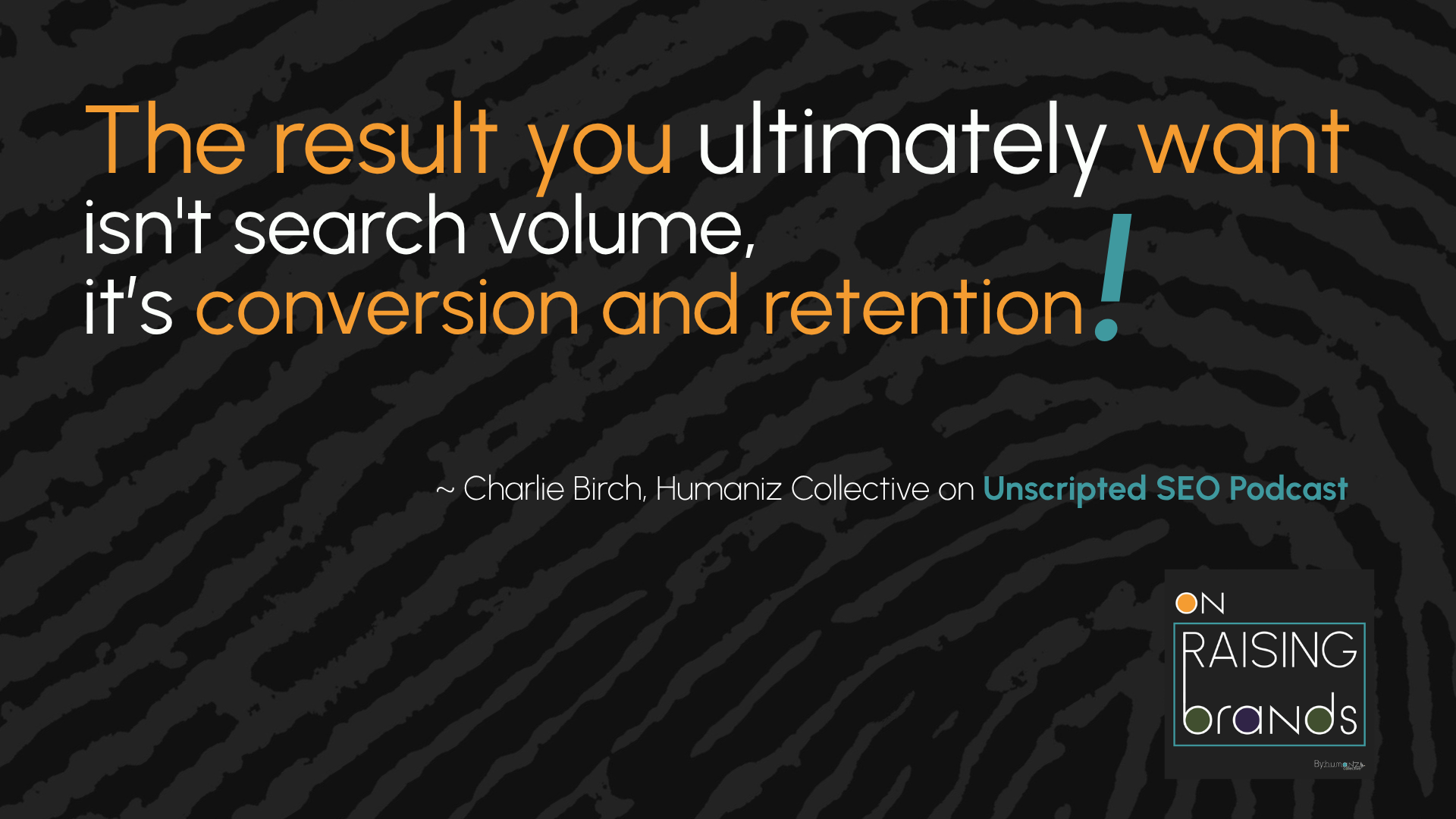
If the SEO research is done well and the keyword research is done well, your pages set the right expectation. But if the content is not up to snuff, you're not going to meet the expectation — and the result you ultimately want isn't search volume, it's conversion and retention.
When Campaigns Succeed at the Wrong Thing
Jeremy Rivera: I've been in scenarios where SEO comes to the table saying "We crushed it — three times the leads!" Then Sales comes back with their worst quarter ever. Because the leads weren't the right people. They weren't decision-makers. That's as much human psychology and understanding the business process as anything else.
What are some of the biggest misses you've witnessed — campaigns that seemed successful but didn't catch the goal?
Charlie Birch: I don't do a lot of campaign management — we're more focused on identity design on the front end. But what I will say is that growth marketers are more confident promising ROI than brand marketers, because they're working with numbers and chasing fiscal results.
What I encourage clients to think about before investing in any campaign: Who is your ideal audience for this? Where do they need to land? What are the sequences of events they need to go through?
Too often, business owners get overwhelmed and just say, "You know what you're doing — you do it for me." They stop evaluating the underlying strategies. But not every sound strategy that gets successful activation elsewhere is the right strategy for your business.
Example: We hired an outsourced lead generation team. They sent scripts "that work for all the other brand agencies in our client pool." But I don't want to use the same strategy as all my competitors. What it's promising is what they think gets results — but those scripts were promising things we immediately couldn't deliver because that's not how our business is structured.
Too few business owners have the ability to look at a campaign with confidence and say: "This is the wrong date for me to go on." It might be valid, it might have had traction in seven other businesses — but this is not the right strategy for us.
The Competitive Fallacy and Finding Your True Differentiator
Jeremy Rivera: We built a content gap analysis tool, and I had to add a warning to it: if you're only looking at what your competitors are doing that you're not — you're just duplicating their business and making yourself more like them.
After you get the content gap data, a counter-function is crucial: What is the gap that none of my competitors are addressing? Because that's the competitor fallacy — if you only duplicate what's working for others, you're only going to get a smaller and smaller piece of the pie.
In one example, we were analyzing a client selling precast concrete walls. The competitor was promising this delivery angle and that delivery angle. We actually interviewed the person who does the installation. And in that conversation, it came up repeatedly: every single time they install these walls, customers ask about anti-dig protection — something deeper in the ground so no one can just dig under the expensive wall.
There was no search volume for that term. But it surfaces in every sales conversation. That competitive angle would never have been found any other way. It always comes back to the human element.
Charlie Birch: That points directly toward our Brand IdQ framework — our signature framework for exactly this question.
We used to carry it out through one-on-one interviews over extensive periods of time. But we've been diligently building our own tech stack around teasing apart the identity of the founder — because we work specifically with founder-led brands in the service-driven space where the human experience is central to long-term success.
We look at: How do I tease the founder identity apart from the brand identity so it can be articulated, codified, and transferred to the whole team? Not just the marketing team — the sales team, the SEO team, the finance team, operations. Everyone gets that same lens of glasses, so they can ask:
"What would the brand do here?"
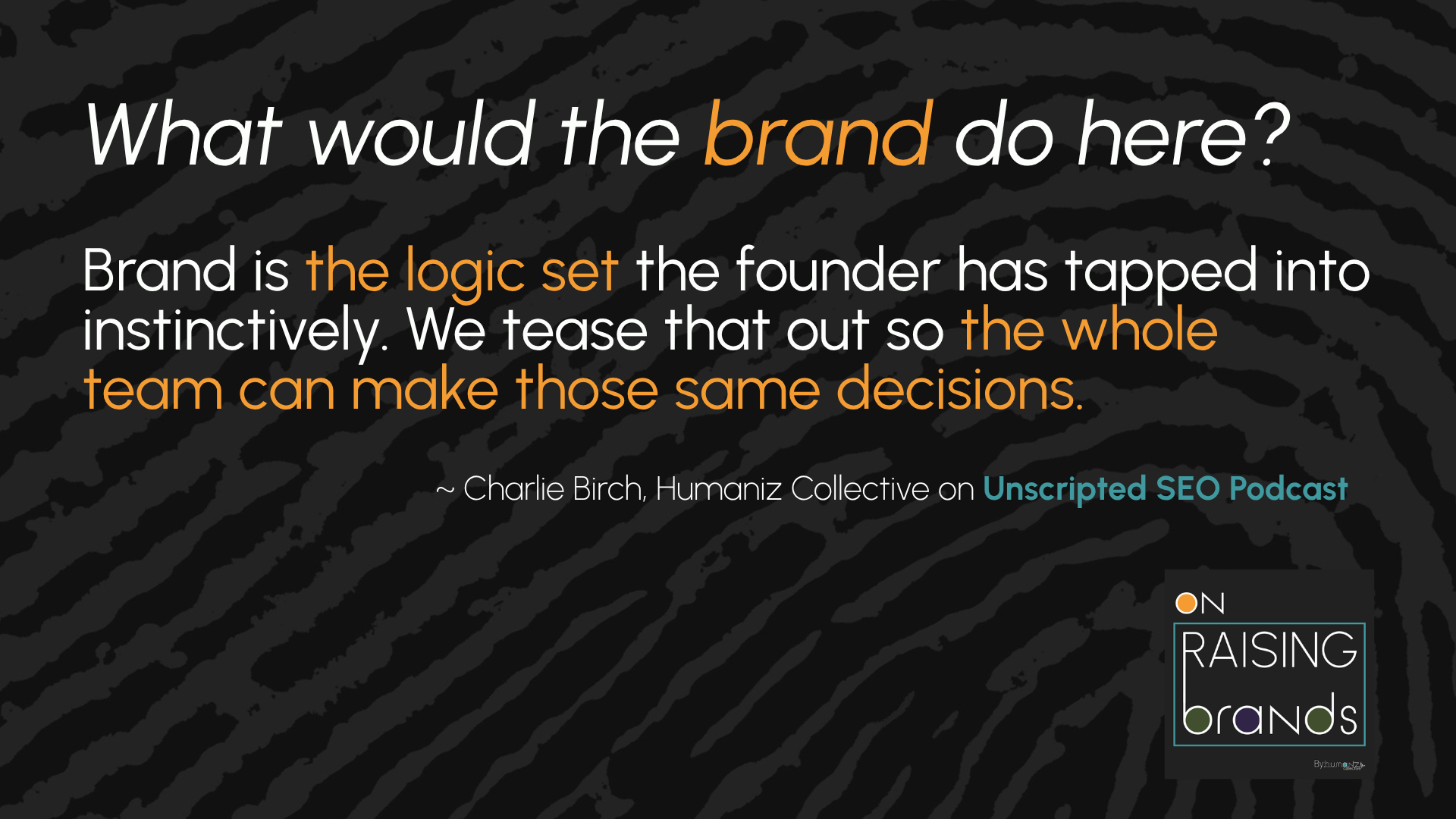
Before mood board, before positioning, before ICP — it's the logic set that the founder has historically tapped into instinctively. We tease that out so the whole organization can make those same sequential decisions.
We have something called the Brand Integrity Statement which very clearly lays out: How the brand is recommended to make decisions. What to be mindful of. What signals indicate you're on the right track. What needs to be fulfilled. What habits to adopt. What relational strategies to deploy.
That relational strategies piece is interesting for the SEO conversation — it helps you figure out what kind of content and keyword approach is actually aligned with your brand's mode of care for clients, not just volume-optimized. Because some of the low-hanging-fruit keywords might produce the most volume upfront but won't promote the best conversion and retention over time.
Ready To Raise Your Brand Up Right, by making aligned strategic decisions v.s running other people’s strategies?
Get your complimentary Brand IdQ™ Integrity Snapshot on our website, a fast, founder‑friendly way to surface your brand logic and focus your efforts accordingly.




Who We Are
"We don’t create brands, because we truly believe that every business already has a brand. Rather, our role is to help founders and their teams embody the brand fully, express it with more clarity, and expand its influence and impact with more confidence."
~ Charlie Birch, Author of On Raising Brands + Founder and Creative Director @ Humaniz Collective
Bringing a brand to market is just the beginning of your brand’s development and life story.
And that’s where we come in!
We’re creative, marketing and operational experts working together to ensure brands come to life from the inside out.
We support brands throughout their lifecycle across three phases of service:
Brand Strategy
Brand Design
Brand Stewardship
If you’re looking for a brand partner to walk beside you, ensuring your brand grows up healthy and strong, makes good life choices, and attracts the right people into its orbit, Humaniz Collective is the obvious choice.
Engage with Brand IdQ - our complimentary brand strategy generator - and let us prove our worth.